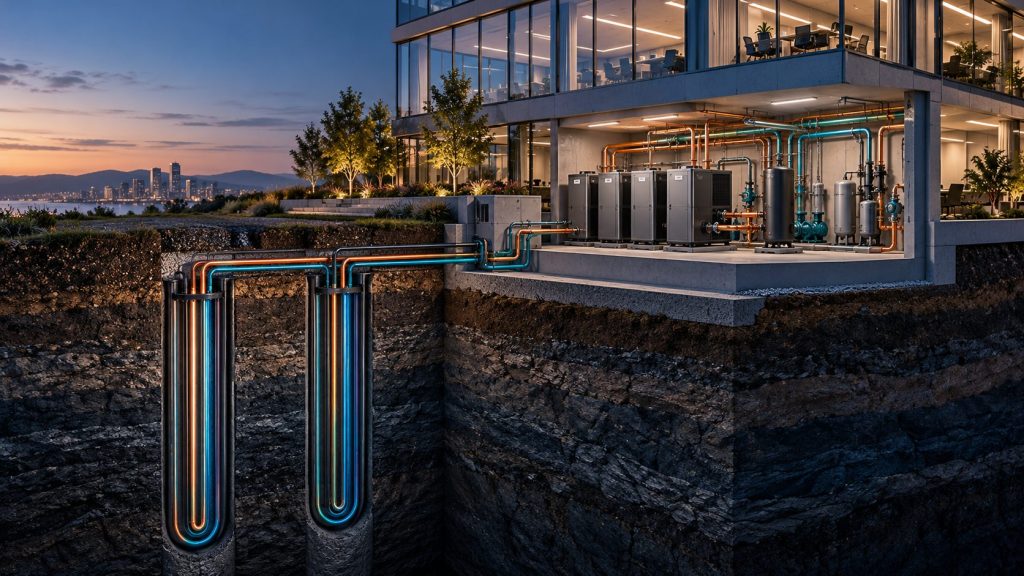
Ground loop
Exchanges heat with the ground. Establish the input and output conditions, equipment boundary, document requirements and responsible party for this stage. Record any supplier deviation before approving the connected package.

MOEWORLDWIDE · Renewable energy / Geothermal Energy
Ground-source heating and cooling and geothermal electricity are different procurement disciplines. Define which pathway your project needs before approaching suppliers. MOEWORLDWIDE can review a sourcing enquiry; specialized power-project equipment remains subject to verified supplier competence and project engineering.
AI-generated concept imagery · Illustrative infrastructure, not a MOEWORLDWIDE facility or completed project.
Technology in context
A ground-source heat pump uses electricity to move heat between a building and the ground through a heat-exchange circuit. It provides heating or cooling rather than generating electricity. Geothermal power generation instead uses a suitable hot underground resource, with a conversion process selected for resource temperature, chemistry and pressure. Resource development and drilling are separate engineering activities.
Equipment in focus
Use the illustrated pathway to identify the interfaces that belong in your request for quotation. The equipment catalog defines the potential component scope; the project engineer must confirm the final arrangement.
Technical request matrix
Ask each supplier to respond against the same schedule. Record its stated value, supporting document, exclusions and any deviation for every relevant parameter.
| Decision area | Information to specify or request |
|---|---|
| Project pathway | Building heating/cooling or hot-resource electricity generation |
| Building thermal design | Peak heating and cooling loads, distribution temperatures and operating hours |
| Ground assessment | Thermal properties, borehole arrangement, groundwater and drilling constraints |
| Heat-pump selection | Capacity and efficiency at stated water temperatures, refrigerant and electrical supply |
| Loop circuit | Pipe material, pressure rating, joining method, antifreeze and flushing requirements |
| Hydraulic duty | Flow, head loss, circulation-pump curves, balancing and expansion |
| Heat exchange | Design temperature, pressure, approach temperature and wetted materials |
| Resource chemistry | Scaling, corrosion, dissolved constituents and non-condensable gases where relevant |
| Controls | Building-management protocol, points list, sequencing and energy metering |
| Installation | Local drilling competence, permits, isolation, access and commissioning |
| Serviceability | Replacement controls, compressor access, filters, seals and maintenance procedures |
| Acceptance | Pressure tests, flushing records, flow balancing and measured operating conditions |
Compare technical conformity, included components, packing, document scope, inspection access, production schedule and delivery responsibilities. Separate equipment cost from freight, insurance, local duties, civil works, installation, commissioning, consumables and service charges. Request validity and payment milestones in writing.
Identify who approves substitutions. Record changes to model numbers, materials, firmware, interfaces and delivery dates before acceptance. Request final drawings, operating manuals, spare-parts lists, test records and a named service contact. Agree the defect-reporting and escalation process before handover.
Renewable energy technologies explained — U.S. Energy Information Administration. This independent introductory reference helps explain the technology; it does not certify a supplier or determine the requirements in your destination.
Continue with the China import quotation checklist and MOEWORLDWIDE sourcing process.
A system-level view
Exchanges heat with the ground
Transfers heat through a closed loop
Uses electricity to move heat
Delivers heating or cooling
Power projects differ: Hot resource → engineered conversion plant → generator; not the heat-pump pathway
Illustrative system boundaries. Expand or collapse each stage for detail. Final equipment interfaces require project engineering.
Thermal loads · ground exchange · resource-led engineering
A better sourcing decision connects the resource, equipment interfaces and operating plan. Explore the system architecture, then use the application and verification notes to develop a comparable supplier enquiry.
Exchanges heat with the ground. Establish the input and output conditions, equipment boundary, document requirements and responsible party for this stage. Record any supplier deviation before approving the connected package.
Transfers heat through a closed loop. Establish the input and output conditions, equipment boundary, document requirements and responsible party for this stage. Record any supplier deviation before approving the connected package.
Uses electricity to move heat. Establish the input and output conditions, equipment boundary, document requirements and responsible party for this stage. Record any supplier deviation before approving the connected package.
Delivers heating or cooling. Establish the input and output conditions, equipment boundary, document requirements and responsible party for this stage. Record any supplier deviation before approving the connected package.
Power projects differ: Hot resource → engineered conversion plant → generator; not the heat-pump pathway. Define this additional scope explicitly so it is not lost between equipment suppliers.
Choose the right project boundary
Use the route that matches your intended operation. Capacity, commercial maturity and local installation conditions can change the appropriate supplier, documentation and acceptance process.
Begin with building heating and cooling loads, distribution temperatures and operating hours. Assess ground thermal properties and the proposed loop arrangement. Select heat-pump performance at the actual entering-water conditions, with pumping energy and long-term ground balance considered.
Confirm groundwater availability, chemistry, abstraction permissions and discharge constraints with local specialists. Heat exchangers, filtration and corrosion-resistant materials may be needed. Do not assume an open-loop option is interchangeable with a closed buried circuit.
Power production requires a suitable hot resource and a separate process design. Resource temperature, pressure, chemistry and gas content govern the conversion route and materials. Specialist plant procurement depends on verified engineering and supplier capability; heat-pump experience alone does not establish power-project competence.
From brochure to evidence
Ask for a dated, model-specific response against your technical schedule. Keep the manufacturer's statements separate from independently checked documents and from items still awaiting project approval. An attractive presentation is not a substitute for traceable equipment identity.
| Review package | Ask the supplier for | Buyer acceptance question |
|---|---|---|
| Equipment identity | Manufacturer legal entity, manufacturing location, model, revision, serial identification and bill of materials. | Does the quotation identify the same equipment as the datasheets, drawings and test records? |
| Technical conformity | A line-by-line compliance schedule, declared deviations, operating limits and interface drawings. | Which requirements are met, which require engineering review, and which are excluded? |
| Quality evidence | Inspection and test plan, sample or factory-test scope, calibration records and traceable reports. | Are test conditions, witness points, pass criteria and report issuers defined before production? |
| نطاق تجاري | Itemized equipment, accessories, documentation, packing, service scope, delivery basis and validity. | Can competing offers be compared on the same boundary without assuming missing items? |
| Service and handover | Manuals, training, commissioning responsibilities, spare-parts schedule and the warranty issuer. | Who responds to a defect, what evidence is required and which costs remain with the buyer? |
Before approving production, resolve open technical questions in a controlled document register. Establish who can authorize changes to materials, controls, firmware, subcontractors or packing. Require written approval for substitutions; a similar product description does not establish an equivalent product.
Anticipate the expensive gaps
Compare capacity and efficiency at the same source and delivery temperatures. Include auxiliary pumps and operating schedules when evaluating system performance rather than relying on one catalog rating.
Check pipe pressure rating, joining procedure, antifreeze compatibility, flushing, balancing and expansion provisions. Document flow and pressure-loss assumptions for each circuit.
Resource chemistry can affect heat exchangers, pumps and seals. Require a maintenance strategy, isolation points, cleaning access and compatible replacement materials for the defined fluid.
Separate equipment price from export packing, inland transport, freight, insurance, destination handling, duties, local taxes, installation, commissioning and initial spares. Obtain actual project quotations for these items; the equipment price is only one part of the buying decision. Compare offers in a consistent currency and record validity, payment milestones and any price-adjustment conditions.
Set inspection access, witness points, quantities, document deliverables and release criteria before production starts. Record nonconformities with an owner and closure date. A factory inspection confirms only the agreed checks at that time; commissioning and final acceptance need their own site-specific procedure and responsible personnel.
Agree preservation, labeling, lifting points, packing photographs and the packing list before dispatch. Keep transport damage reporting separate from product defect reporting. Request the final approved drawings, operating instructions, spare-parts identifiers and named service contact as part of the handover package.
Understand the quotation language
The ratio of useful heating or cooling output to electrical input at stated conditions. A test-point figure is not automatically a seasonal result.
The source-side temperature at the heat pump. It is central to capacity, efficiency and operating-limit checks.
The relationship between heat removed from and returned to the ground over time. It influences long-term loop design.
Use the Renewable energy technologies reference for independent technology context. Review the China import quotation checklist, understand the supplier review and export coordination process, and compare the six renewable energy equipment categories. These resources help structure an enquiry; destination requirements and final engineering remain specific to the project.
What to send first: Heating/cooling or electricity pathway; project country; thermal loads or resource data; ground conditions; loop concept; entering and leaving temperatures; fluid chemistry; electrical supply; drilling and installation scope; timeline; delivery terms. If the design is incomplete, identify the missing information rather than filling the gaps with assumptions. The team can then assess whether a supplier search is appropriate and define the next review step.
Request a geothermal energy sourcing review →Contact the China sourcing team →Equipment and component scope
Use these categories to prepare a specification, not as a statement of confirmed inventory. Ask for the exact model, compatible interfaces and the documentation relevant to your destination.
Water-to-water and water-to-air units serve suitable commercial or residential heating and cooling systems. Request capacity and efficiency at stated entering-water temperatures, electrical supply, refrigerant, operating limits and acoustic data. Match the ground loop and building distribution temperatures. Verify test conditions, destination approvals, service access and installation manuals.
Closed-loop pipes, fittings and manifolds transfer heat to and from the ground. Specify pipe material, pressure rating, thermal duty, loop geometry and joining method. Confirm fluid compatibility, burial or borehole arrangement and flow balancing. Obtain material records, joining procedures, pressure-test requirements and as-built documentation.
Pumps move loop fluid and heat exchangers separate circuits where needed. Request duty flow, pressure loss, fluid properties, design temperatures and corrosion allowances. Match control valves, filters and expansion equipment. Review performance curves, wetted materials, pressure-test evidence and maintenance access.
Controls coordinate heat pumps, circulation and building demand. Specify sensors, sequencing, metering, alarms, communications and remote-access requirements. Confirm compatibility with the building-management system. Request control narratives, wiring diagrams, points lists, calibration information and commissioning records.
Heat exchangers, pumps, separators and conversion equipment may be considered only where the resource and supplier capability support the project. Request temperature, pressure, chemistry, non-condensable gas and scaling data. Confirm materials, process interfaces and maintainability through qualified engineering. Review project-specific manufacturing qualifications and inspection plans before treating equipment as procurable.
Applications and buyer profiles
Building owners and MEP contractors should prioritize thermal-load data, distribution temperatures and space for plant access. Heat-pump distributors need climate-appropriate documentation and installation support. Geothermal power developers need a resource-led engineering specification, specialist procurement oversight and a confirmed supply route.
Technical selection
A building heat-pump design needs heating and cooling loads, ground thermal properties and long-term thermal balance. Local rules govern drilling, groundwater protection, refrigerants and installation. Power projects require detailed geology, resource temperature, pressure and fluid chemistry. Corrosion, scaling and gas management can dominate materials selection and operating cost.
Supplier documentation and quality
For heat pumps, verify model-specific performance at relevant operating conditions and electrical compatibility. For loop systems, agree pressure-test and joining records. For hot-resource equipment, review material selection, pressure design, welding and inspection documentation with the project engineer. Do not infer power-generation capability from a heat-pump supplier's catalog.
Logistics and operational support
Confirm equipment orientation, lifting points, freeze protection and preservation instructions. Define responsibility for drilling, loop installation, flushing, balancing, electrical connection and commissioning. Secure access to replacement controls, compressors or seals as applicable. After-sales arrangements should identify the service provider, response process and exclusions without assuming a warranty term.
MOEWORLDWIDE's role, supplier access, inspection arrangements and export deliverables must be agreed for your project. Prices, availability, minimum quantities, warranties and manufacturer approvals are not assumed.
Procurement questions
No. It consumes electricity to transfer heat for heating or cooling. Geothermal electricity requires a suitable hot resource and a different plant.
A preliminary area estimate is insufficient for procurement. Use a thermal-load calculation, ground assessment and defined design temperatures.
Drilling and local installation are separate scopes unless expressly agreed with qualified, authorized contractors.
Connected procurement
Your project starts with a clear brief
Send the information below so the team can assess supplier suitability and agree a sourcing scope. Capacity, availability, commercial terms and support are confirmed only in a written offer.
Heating/cooling or electricity pathway; project country; thermal loads or resource data; ground conditions; loop concept; entering and leaving temperatures; fluid chemistry; electrical supply; drilling and installation scope; timeline; delivery terms.
Privacy: the information you submit is used to assess and respond to this enquiry and coordinate relevant sourcing discussions. Share only the technical information needed at this stage. Do not include passwords, payment details or confidential engineering files. For technical documents, request an agreed secure sharing route from Contact@moeworldwide.com.