
Networking & connectivity
Source fiber transceivers from China
Fiber transceiver sourcing starts with both endpoints, the fiber plant and the speed or distance target. Compare pluggable optics by host support, link budget and interoperability at the intended temperature. Request proof of compatible modules and cables rather than quoting based on connector shape alone.
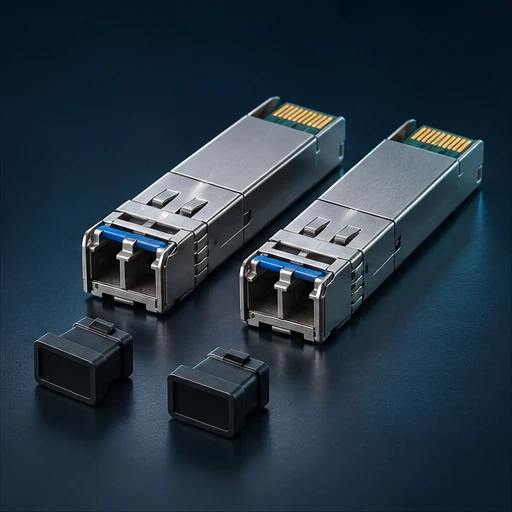
Fiber Transceivers by application
Choose the format that fits your buyer’s environment, operating requirements and support plan. Use the exact model identifier in every quotation and sample request.
Short-reach optical module
Match fiber grade, speed and connector to the installed multimode path and board support.
Single-mode long-reach module
Specify wavelength, loss, required distance, receiver limits and transceiver at the opposite end.
Bidirectional module
Verify complementary transmit and receive wavelengths on the same fiber strand and record the matched pair.
Inside and outside the product
Explore the enclosure, interfaces and internal assembly. Open each component to see what it does and which design details affect sourcing.
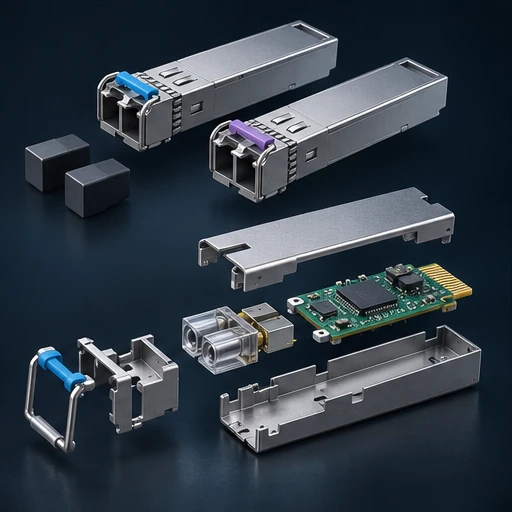
Optical assemblies
Transmit and receive light through the connector. Wavelength and power must match the optical path.
Signal circuitry
Drive and condition high-speed electrical and optical channels.
Host connector
Fits the port cage and exchanges data and diagnostic information.
Shell and latch
Establish fit, cooling and removal. Heat transfer varies with cage and neighboring modules.
Diagnostic memory
Reports identifying and operating data where supported by the host and protocol.
Fiber Transceivers specification table
Ask each supplier to state a proposed value, supporting evidence and any deviation for the exact model it quotes. Measure samples under the same operating conditions before confirming the final configuration.
| Parameter | Specify or request from the supplier |
|---|---|
| Link plan | Specify speed, wavelength, fiber type, strand count, distance and connector polish or type. |
| Link budget | Ask for power and receiver limits, path loss allowance, attenuation and monitoring values. |
| Host support | Confirm port format, firmware, vendor coding where applicable and diagnostics. |
| Operating conditions | State temperature class, insertion cycles, cage clearance and adjacent port density. |
| Evidence | Require test sheets, serial and lot records and supported error-rate test. |
| Accessory | List matched cable, dust caps, cleaning accessories and any required attenuation. |
Compare the offer line by line
Compare module, cable and replacement terms together. Confirm warranty for incompatibility based on a documented host and firmware combination.
Record unit price, minimum order by configuration, sample cost, lead time and quoted handover terms. Use the China import quotation checklist to compare the cost and inclusions of each offer.
From sample to shipment inspection
Agree the sample, test method and acceptance limits before releasing a production order. Build the report around the product’s expected use and the components that can change between lots.
Link validation
Establish both ends on target switches and run sustained traffic. Review optical readings with the intended path or validated equivalent.
Part release
Lock wavelength pair and firmware. Agree serial traceability and connector cleanliness checks.
Final inspection
Verify physical fit, latch, labeling, dust caps and test sample optical power and link.
See how supplier selection and inspection coordination fit into the MOEWORLDWIDE sourcing process.
Documentation, packing and export
Document review
Request exact-model safety and technical records, including optical classification evidence where relevant. Review parts provenance, firmware and lot records to confirm the shipped devices match the validated pair.
Freight and carton details
Keep dust caps fitted and use sealed, anti-static trays. Separate wavelengths and paired identifiers and include label crosswalk for spares.
Confirm the commercial invoice, packing list, delivery term, cargo handover and any destination-specific documents with the parties responsible for the shipment.
Request a sourcing quote for fiber transceivers
Share the details below so MOEWORLDWIDE can compare offers on the same scope, including the supplied configuration, documentation, inspections and delivery terms.
- Application and market. Identify the short-reach optical module, single-mode long-reach module or another configuration you are evaluating, and name the destination country and receiving city or port.
- Product specification. Include your target values for link plan, link budget, host support and attach a current drawing, reference unit or datasheet if available.
- Order and packaging. List quantity by model, trial order size, likely repeat volume, required pack languages, accessories and target delivery date.
- Evidence and terms. List required reports, sample approvals, inspection scope, warranty expectations and preferred freight handover point.