Marine energy sourcing, grounded in project maturity.
Ocean energy procurement requires an honest view of technology readiness, site conditions and marine access. MOEWORLDWIDE can assess a component-sourcing enquiry and investigate supplier suitability; no emerging system is presented here as a standard, export-ready package.
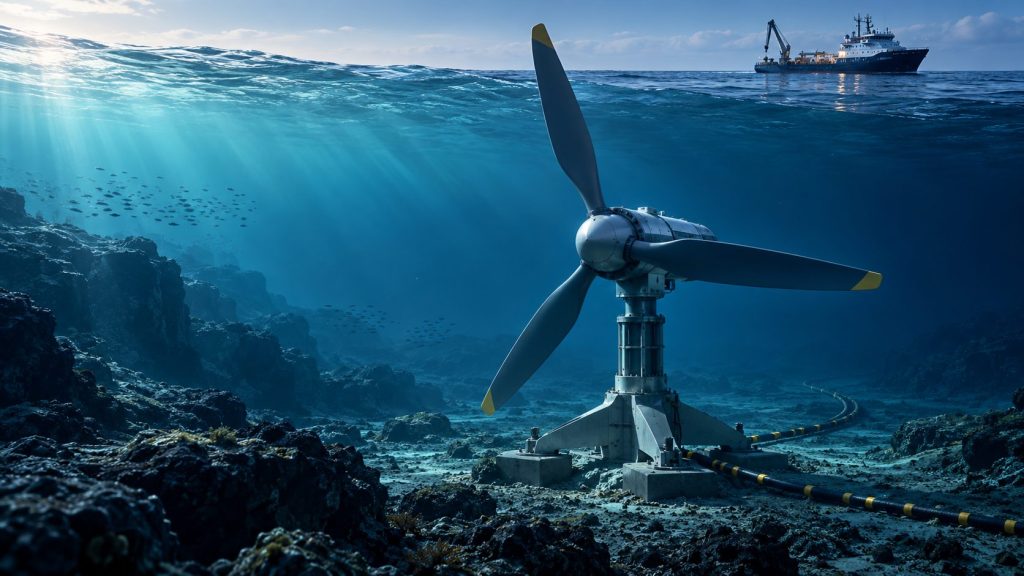
AI-generated concept imagery · Illustrative infrastructure, not a MOEWORLDWIDE facility or completed project.
Technology in context
How ocean energy works
Tidal-stream devices extract energy from moving tidal currents. Wave-energy converters capture wave motion through device-specific mechanisms. Tidal-range projects use water-level differences across engineered structures. Ocean thermal energy conversion uses a suitable temperature difference between warm surface water and cold deep water. Conventional offshore wind uses wind rather than the ocean resource and belongs in the wind sector.
Equipment in focus
A visual guide to the ocean energy system
Original explanatory graphic. Simplified equipment relationships; not an installation drawing or evidence of a supplied project.
Use the illustrated pathway to identify the interfaces that belong in your request for quotation. The equipment catalog defines the potential component scope; the project engineer must confirm the final arrangement.
Technical request matrix
What to put in your ocean energy RFQ
Ask each supplier to respond against the same schedule. Record its stated value, supporting document, exclusions and any deviation for every relevant parameter.
Project information and supplier response topics
Decision area
Information to specify or request
Technology status
Component, prototype, demonstration or commercially supported system
Resource evidence
Current distribution, sea states, tidal head or thermal gradient
Marine site
Water depth, bathymetry, seabed, navigation and environmental constraints
Structural design
Cyclic loads, extreme events, fatigue basis and survivability strategy
Conversion package
Tidal rotor, wave power take-off, tidal-range turbine or thermal conversion scope
Marine materials
Corrosion allowance, coatings, cathodic protection and biofouling management
Electrical interfaces
Generator, converter, protection, subsea export cable and terminations
Mooring or foundation
Anchors, installation tolerances, geotechnical assumptions and inspection access
Deployment
Port capacity, vessel capability, weather windows, permits and lifting
Operations
Remote monitoring, retrieval strategy, offshore intervention and spares
Commercial evidence
Operating data at relevant scale, ownership, licensing and supplier eligibility
Acceptance
Qualification tests, deployment milestones, recovery demonstration and defined uncertainty
Quotation comparison
Compare technical conformity, included components, packing, document scope, inspection access, production schedule and delivery responsibilities. Separate equipment cost from freight, insurance, local duties, civil works, installation, commissioning, consumables and service charges. Request validity and payment milestones in writing.
Change control and handover
Identify who approves substitutions. Record changes to model numbers, materials, firmware, interfaces and delivery dates before acceptance. Request final drawings, operating manuals, spare-parts lists, test records and a named service contact. Agree the defect-reporting and escalation process before handover.
Marine operations: Moorings, retrieval and maintenance access govern deployment
Illustrative system boundaries. Expand or collapse each stage for detail. Final equipment interfaces require project engineering.
Marine resource · survivability · deployment and recovery
Ocean Energy procurement: the engineering behind the equipment
A better sourcing decision connects the resource, equipment interfaces and operating plan. Explore the system architecture, then use the application and verification notes to develop a comparable supplier enquiry.
Original conceptual equipment visualization. The shapes identify procurement interfaces; they are not product drawings, performance data or evidence of a supplied installation. Read the detailed stages below on any screen size.
INTERFACE 01
Marine resource
Currents, waves, tidal head or thermal gradient. Establish the input and output conditions, equipment boundary, document requirements and responsible party for this stage. Record any supplier deviation before approving the connected package.
INTERFACE 02
Conversion device
Technology-specific energy capture. Establish the input and output conditions, equipment boundary, document requirements and responsible party for this stage. Record any supplier deviation before approving the connected package.
INTERFACE 03
Power + controls
Conditioning and protection. Establish the input and output conditions, equipment boundary, document requirements and responsible party for this stage. Record any supplier deviation before approving the connected package.
INTERFACE 04
Subsea export / shore
Engineered cable and landfall. Establish the input and output conditions, equipment boundary, document requirements and responsible party for this stage. Record any supplier deviation before approving the connected package.
Marine operations: Moorings, retrieval and maintenance access govern deployment. Define this additional scope explicitly so it is not lost between equipment suppliers.
Choose the right project boundary
Different applications need different procurement briefs
Use the route that matches your intended operation. Capacity, commercial maturity and local installation conditions can change the appropriate supplier, documentation and acceptance process.
Tidal-stream devices
Provide current distribution, turbulence, water depth, bathymetry and seabed information. Coordinate rotor, foundation or mooring, subsea electrical interfaces and vessel access. Evaluate energy capture together with extreme loading, retrieval and maintenance requirements.
Wave energy systems
Specify the sea-state distribution and survival environment. Power take-off, mooring, fatigue, control strategy and storm behavior are closely linked. Prototype results do not automatically establish commercially supported performance at a different scale or site.
Tidal-range and thermal routes
Tidal-range schemes depend on civil structures and hydraulic operating regimes. Ocean thermal systems depend on a suitable temperature gradient and substantial seawater interfaces. Both need specialist engineering, permits and a project-specific supplier assessment.
From brochure to evidence
What a complete supplier response should contain
Ask for a dated, model-specific response against your technical schedule. Keep the manufacturer's statements separate from independently checked documents and from items still awaiting project approval. An attractive presentation is not a substitute for traceable equipment identity.
Supplier evidence and buyer review schedule
Review package
Ask the supplier for
Buyer acceptance question
Equipment identity
Manufacturer legal entity, manufacturing location, model, revision, serial identification and bill of materials.
Does the quotation identify the same equipment as the datasheets, drawings and test records?
Technical conformity
A line-by-line compliance schedule, declared deviations, operating limits and interface drawings.
Which requirements are met, which require engineering review, and which are excluded?
Quality evidence
Inspection and test plan, sample or factory-test scope, calibration records and traceable reports.
Are test conditions, witness points, pass criteria and report issuers defined before production?
alcance comercial
Itemized equipment, accessories, documentation, packing, service scope, delivery basis and validity.
Can competing offers be compared on the same boundary without assuming missing items?
Service and handover
Manuals, training, commissioning responsibilities, spare-parts schedule and the warranty issuer.
Who responds to a defect, what evidence is required and which costs remain with the buyer?
Before approving production, resolve open technical questions in a controlled document register. Establish who can authorize changes to materials, controls, firmware, subcontractors or packing. Require written approval for substitutions; a similar product description does not establish an equivalent product.
Anticipate the expensive gaps
Three issues to resolve before placing an order
REVIEW 01
Technology readiness gap
Ask whether the offer is for a component, prototype, demonstration device or supported commercial system. Request independently reviewable operating evidence at relevant scale and conditions.
REVIEW 02
Corrosion and fatigue
Define material compatibility, coatings, cathodic protection, seal arrangements and inspection access. Marine biofouling and repeated loads can affect both performance and maintenance.
REVIEW 03
Deployment and retrieval exposure
Review port limits, vessel availability, lifting, weather windows, cable installation and emergency recovery. A low equipment price can conceal a high offshore intervention cost.
Build the landed-cost comparison
Separate equipment price from export packing, inland transport, freight, insurance, destination handling, duties, local taxes, installation, commissioning and initial spares. Obtain actual project quotations for these items; the equipment price is only one part of the buying decision. Compare offers in a consistent currency and record validity, payment milestones and any price-adjustment conditions.
Plan acceptance and handover before shipment
Set inspection access, witness points, quantities, document deliverables and release criteria before production starts. Record nonconformities with an owner and closure date. A factory inspection confirms only the agreed checks at that time; commissioning and final acceptance need their own site-specific procedure and responsible personnel.
Agree preservation, labeling, lifting points, packing photographs and the packing list before dispatch. Keep transport damage reporting separate from product defect reporting. Request the final approved drawings, operating instructions, spare-parts identifiers and named service contact as part of the handover package.
Understand the quotation language
Key ocean energy terms for buyers
Power take-off
The subsystem that converts device motion into useful mechanical or electrical output. Its duty cycle must reflect the marine resource.
Survivability
The ability to withstand defined extreme conditions. It needs a documented design and verification basis.
Retrieval strategy
The planned method for recovering equipment for inspection, service or decommissioning, including the necessary vessels and weather limits.
What to send first: Technology and maturity stage; country and marine site; resource measurements; bathymetry and seabed data; target scale; component or full-system scope; environmental constraints; cable landfall; vessel access; deployment window; delivery terms. If the design is incomplete, identify the missing information rather than filling the gaps with assumptions. The team can then assess whether a supplier search is appropriate and define the next review step.
Use these categories to prepare a specification, not as a statement of confirmed inventory. Ask for the exact model, compatible interfaces and the documentation relevant to your destination.
01 / Procurement category
Tidal-stream turbines
Submerged rotors convert current energy into mechanical and electrical output. Request current-speed range, water depth, turbulence, rotor configuration and retrieval method. Match foundation or mooring design, power electronics and subsea export. Verify technology maturity, operating evidence, fatigue assumptions and marine inspection requirements for the actual device.
02 / Procurement category
Wave-energy converters
Wave devices use differing motion-capture and power-take-off architectures. Many designs remain in development or demonstration; assess the specific system rather than assuming a standardized product. Request sea-state envelope, survivability strategy, output evidence and maintenance history. Confirm moorings, power take-off, controls and recovery procedures with the technology owner.
03 / Procurement category
Tidal-range equipment
Turbines, gates and controls may form part of a larger barrage or lagoon project. Request tidal head and flow distributions, reversible-duty requirements, civil interfaces and sediment conditions. Confirm project-scale engineering and environmental approval. Review hydraulic evidence, structural documentation and access arrangements; civil and permitting scope is substantial.
04 / Procurement category
Ocean thermal components
Heat exchangers, seawater pumps, pipes and conversion components may support an OTEC project where conditions and commercial scope justify them. Request thermal gradient, seawater flows, biofouling limits and parasitic-power assumptions. Match large seawater circuits and conversion equipment. Verify scale-specific operating evidence and supplier capability; commercial availability is project-dependent.
05 / Procurement category
Marine generators and subsea cables
Generators, wet-environment interfaces, export cables and terminations connect the conversion device to shore. Request voltage, power, water depth, dynamic loading and installation duty. Confirm bend limits, termination compatibility and protection design. Review factory tests, cable qualification, watertightness evidence and installation procedures.
06 / Procurement category
Moorings, corrosion protection and monitoring
Moorings, coatings, cathodic protection, sensors and controls support marine integrity. Specify seabed conditions, cyclic loads, corrosion allowance, biofouling and communications. Confirm materials compatibility, inspection access and retrieval strategy. Obtain engineering calculations, material traceability, calibration records and an agreed maintenance plan.
Applications and buyer profiles
Who this sourcing brief is for
Technology developers may need traceable components for a prototype or demonstration campaign. Research and public-procurement teams need transparent readiness criteria and acceptance milestones. Commercial developers need independent engineering, a credible operations model and a verified supplier route before placing a system order.
Technical selection
What to resolve before comparing offers
Characterize currents, waves, tides, depth, seabed and extreme events. Assess navigation, fisheries, habitats, grid landfall and local permitting. Evaluate fatigue, corrosion, biofouling, survivability and recovery cost. Establish whether the procurement concerns a component, prototype, demonstration unit or commercially supported system; readiness varies by technology and developer.
Supplier documentation and quality
Build an evidence-based acceptance plan
Request operating and deployment evidence at the relevant scale, technical ownership or licensing authority, design review and test reports. Confirm which claims are independently validated and which are projections. Agree component qualification, witness points, retrieval tests and project acceptance criteria. A concept render is an explanation, not evidence of a completed installation.
Logistics and operational support
Plan beyond the purchase order
Plan specialist packing, corrosion protection, sea fastening and port lifting. Deployment depends on vessels, weather windows, permits and qualified marine contractors. Specify spare strategy, offshore intervention limits, retrieval tooling and onshore maintenance arrangements. Equipment price alone does not establish a viable deployment or service plan.
MOEWORLDWIDE's role, supplier access, inspection arrangements and export deliverables must be agreed for your project. Prices, availability, minimum quantities, warranties and manufacturer approvals are not assumed.
Procurement questions
Ocean Energy sourcing FAQs
Is ocean energy the same as offshore wind?
No. Tidal, wave and ocean thermal systems use marine resources. Offshore wind harvests wind and has a separate equipment and service chain.
Can all technologies be ordered as commercial packages?
No. Some devices remain at prototype or demonstration stages. Supplier capability, licensing, commercial support and export availability require case-by-case verification.
What should be agreed before a demonstration order?
Define readiness evidence, test objectives, acceptance milestones, deployment and recovery responsibilities, permits, insurance and the treatment of technical uncertainty.
Send the information below so the team can assess supplier suitability and agree a sourcing scope. Capacity, availability, commercial terms and support are confirmed only in a written offer.
Technology and maturity stage; country and marine site; resource measurements; bathymetry and seabed data; target scale; component or full-system scope; environmental constraints; cable landfall; vessel access; deployment window; delivery terms.
Privacy: the information you submit is used to assess and respond to this enquiry and coordinate relevant sourcing discussions. Share only the technical information needed at this stage. Do not include passwords, payment details or confidential engineering files. For technical documents, request an agreed secure sharing route from Contact@moeworldwide.com.